
Types of strain gauges: Which one should I choose for my application?
Do you require some strain gauges for your application, but you have no idea which strain gauge to purchase? Look no further than our help guide. If you’re still unsure after this article, do not hesitate to contact our application engineers, and we will help you out. We offer a wide range of strain gauges from our supplier TML.
Before the right strain gauge can be selected, the measurement goal needs to be clearly set. The question that needs to be answered is whether the strain gauge will be used for experimental tests, durability tests or transducer manufacturing.
Strain measurement is imperative to mechanical testing as it validates a structure’s design and offers valuable data for element analysis. We have created this blog to help you pick which strain gauge would be the most suitable for your application. However, if you require any further help, please do not hesitate to contact us!
Strain Gauge Shapes
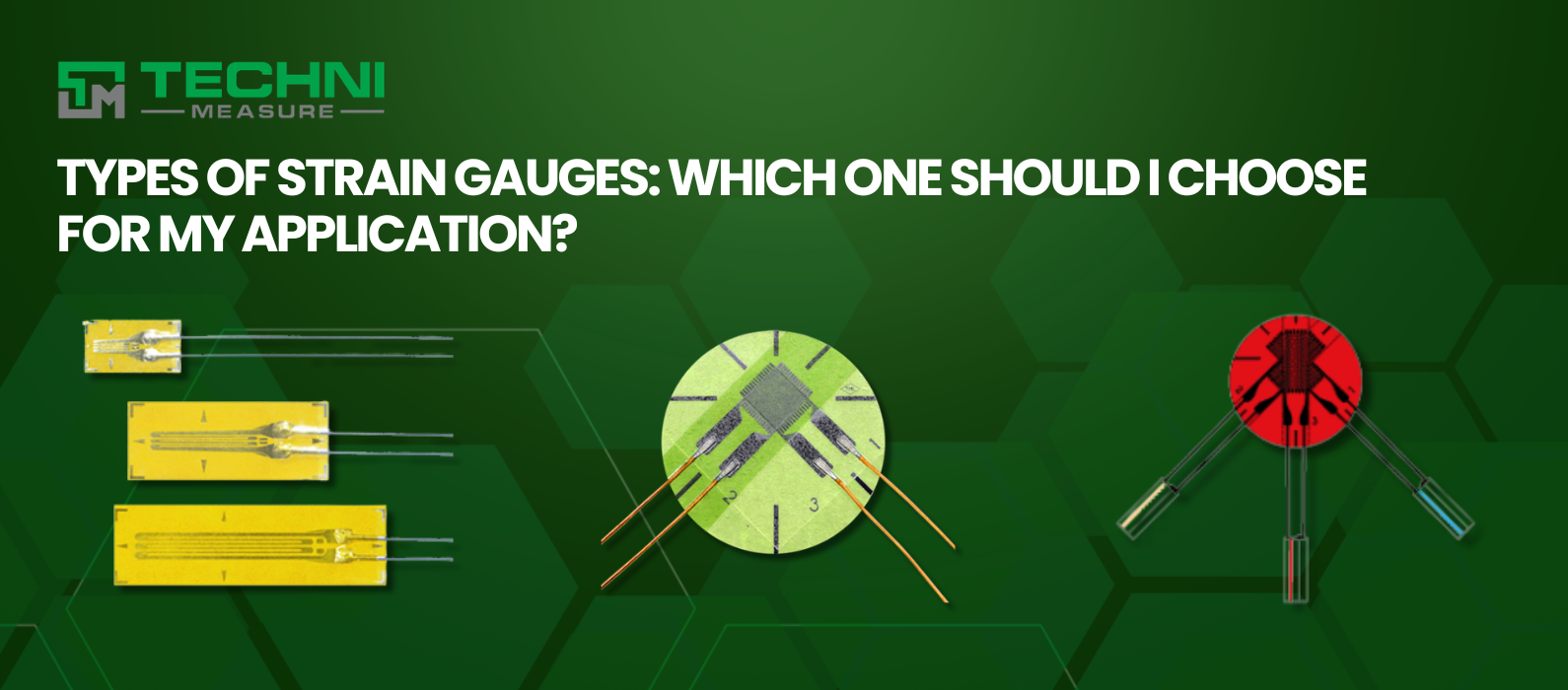
Strain gauges are available in shapes suitable for any application. Select a gauge shape that meets the measuring goals.
Linear Strain Gauges: Single-element gauges designed for measuring uniaxial strain in one direction.
Double Linear: Measures two grids arranged parallel to each other, used for double-sided measurements.
There are many types of strain gauges for a wide range of applications.
Strain Gauge Types and Construction
Both wire and foil strain gauges take the form of a grid pattern mounted within or onto an insulating carrier, capable of faithfully transmitting the strain from the specimen. Weldable gauges have their resistive elements mounted onto a metal carrier. Gauges can often be supplied with their elements heat-treated to provide temperature compensation for use on different materials.
1) Foil Gauge: The foil gauge consists of a metallic alloy film laminated onto an insulating carrier. In a similar way to printed circuit manufacturing techniques, this metallic deposit is masked and then etched to leave a resistance grid. A very wide variety of shapes and sizes is possible with this manufacturing technique, and different alloys and base materials offer a wide selection of gauges most suited to specific temperature or measurement applications. Special configurations are available which provide two or three separate grids precisely located with respect to one another. Active gauge lengths are available from 0·2mm to 30mm, and resistances vary from 60W up to 2000W.
2) Wire Gauge: The wire gauge consists of a grid of fine wire sandwiched between very thin insulating membranes. This carrier serves as a support and protection for the grid and also as an electrical insulator between the wire and the test surface. Gauges are available with nominal resistance generally of 120W in gauge lengths up to 120mm. Special configurations are also available, which provide two or three separate wire grids on one carrier. Except for special applications, the wire gauge has been largely superseded by the foil gauge.
3) Weldable Gauge: The weldable gauge is designed to be spot-welded to a metal test specimen. Minimal surface preparation is required, which enables fast application. Its construction makes it most useful for measurements in harsh environments for long periods or at very high temperatures. Gauges are normally available in effective gauge lengths from 6mm to 16mm, but generally only as single elements. Resistance values are usually 120W or 350W.
Choice of Gauge
There may be an application where a specific gauge designed for a particular measurement task is required, such as residual stress determination, bolt force or internal concrete strain evaluation. Otherwise, for general strain measurement, the choice must be made according to several criteria.
These include anticipated strain level, operational temperature, installation and test environmental conditions, material being tested, temperature compensation, specimen and strain gauge carrier compatibility with chosen adhesive, and finally, gauge length. A short gauge length should only be chosen where the size of the specimen or expected stress concentration so dictates. Specimen materials formed of compacted or bound materials (cement, concrete, chipboard etc.) require gauge lengths to be at least three times that of the maximum particle size. Apart from this consideration, there is no advantage in choosing a long gauge. In general, ease of handling and installation, adhesive application, space availability and adequate performance will suggest a foil gauge of between 3 and 10mm for use on metals.
Gauge area, in conjunction with gauge resistance, has also to be taken into account when total instrumentation stability is considered. The gauge’s resistance and excitation voltage both dictate the power being generated at the gauge, which, along with the gauge’s area, will determine the power density. The amount of heat generated should be sufficiently small so that, over the period of measurement, there is acceptable temperature stability. As a guide, 0·005 watts/mm2 would be acceptable for static tests on metal specimens using foil gauges where moderate accuracy was required. Foil gauges, by having a greater surface area/resistance ratio, can dissipate heat better than wire gauges of the same size.
Metal specimens are better heat sinks than (e.g.) plastics, whilst short-term or dynamic measurements require less fundamental accuracy than those of static conditions or long-term duration, so that the recommended power density figure can vary.
