
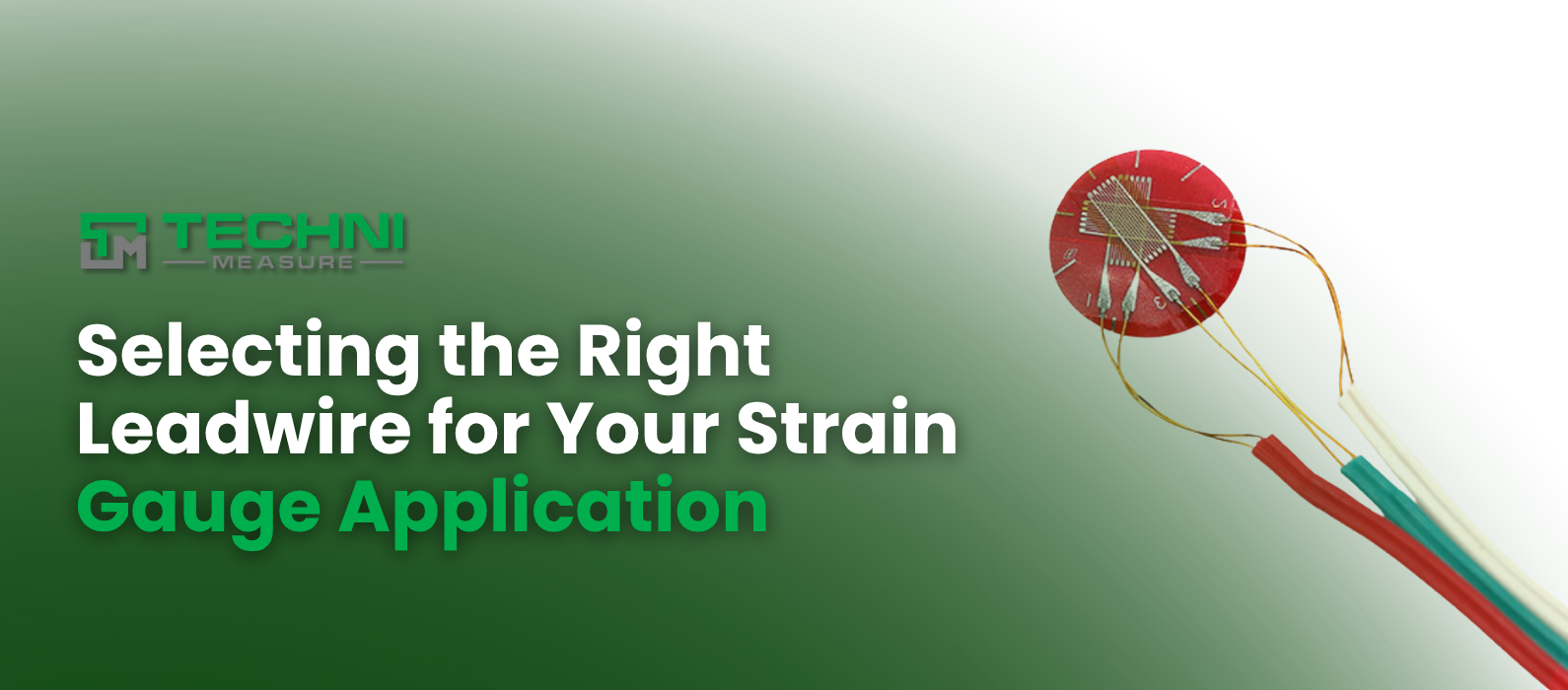
Selecting the Right Lead Wire for Your Strain Gauge Application
The success of your measurement depends on the right connection cable, also known as a lead wire. Selecting the right lead wire for your strain gauge application is crucial. Not only do they have to transfer the measurement signals from the sensor to the DAQ system, but they also have to avoid interference signals and resist stress during use. There are some important points to consider when selecting the right cable for your application.
We offer a variety of lead wires that can be chosen based on specific usage conditions. Most TML strain gauges can come with a pre-attached extension lead wire, which simplifies installation and saves you time. Strain gauges are connected to strain measuring instruments using these extension lead wires. If you need a strain gauge with a pre-attached lead wire, please feel free to contact us.
Standard leadwire length for leadwire-integrated strain gauges:
Standard lengths of our integral leadwires are 1m, 3m, and 5 m (except enamel leadwires). The standard lengths of enamel lead wires are 0.3m, 0.5m and 2m. Other lengths than the standard may be available on request.
Leadwire Selection
1. Vinyl Leadwires (Standard lengths: 1m, 3m, 5m)
Vinyl lead wires are widely used as strain gauge lead wires and are available in a variety of types. Because the vinyl insulation can be coloured, these wires allow colour-coding for rosette gauges. Standard core wires are flexible and easy to handle, and allow easy wire connection and terminal attachment.
Small-Diameter Vinyl Wires (Code to order -LH, -LHT)
These lead wires feature thin vinyl-insulated materials and small-diameter core wires to achieve an outside diameter of 0.4mm. They are used for wiring in tight spaces. The stranded wires are flexible and minimise breakage due to repeated bending.
Shielded Vinyl Wires (Code to order -LTSA, LTSB)
These are 3-core wires with a shield made of aluminium foil or braided copper wire. The outer insulation is made of vinyl. These lead wires offer a noise-shielding function.
2. Enamel Leadwires (Standard Lengths: 0.3m, 0.5m and 1m)
Enamel leadwires have a single core insulated with a resin. Heat resistance and handling methods vary depending on the resin. Because the wire mass and diameter are small, enamel leadwires are used for strain measurement of rotating specimens and/or measurement of multiple points located in close proximity. Since the enamel leadwire contains one core covered with a thin resin, it must be handled with care.
Polyurethane Leadwires
Polyurethane leadwires allow easy post-processing because the resin can be removed with a soldering iron. The resin is not strong, therefore, polyurethane wires must be handled with special care.
Polyester Leadwires
Polyester leadwires are harder than polyurethane wires. They cannot be removed with a soldering iron.
Polyimide Leadwires
Polyimide leadwires are harder than the polyester wire. A soldering iron cannot be used for post-processing.
3. Cross-Linked Vinyl Leadwires (Standard lengths: 1m, 2m and 5m)
The cross-linked vinyl insulation provides improved resistance against environmental elements. It is often used for underwater measurement at ordinary temperatures.
4. Cross-Linked Polyethylene Leadwires (Standard lengths: 1m, 2m and 5m)
The cross-linked polyethylene leadwire offers higher durability than the cross-linked vinyl leadwire. Cross-linked polyethylene leadwires can be used in steam, warm water and concrete with virtually no insulation degradation.
5. Special Leadwire for Temperature-Integrated Gauge (Standard Lengths: 1m, 3m and 5m)
The special leadwire for temperature-integrated gauge consists of 2-core copper and 1-core constantan. To extend this wire, the exclusive lead wire should be applied properly.
6. Fluorinated Resin Leadwire (Standard lengths: 1m, 3m, 5m)
With fluorinated resin leadwires, these leadwires can be used in a wide range of temperatures from extremely low to high temperatures.
Fluorinated resin resists most chemicals. A surface treatment (tetra-etching) is not required by 6FAS_LT(-F).
How are Integral Leadwires Jointed
Most TML strain gauges are available with extension lead wires pre-attached for customer convenience. We have several methods for connecting lead wires to choose from, depending on conditions such as the type of strain gauge and lead wire, measurement environments, and so on.
Integral type: A vinyl lead wire is connected to polyamide-insulated gauge leads of a strain gauge. The solder joints are covered with the vinyl insulation of the lead wire. This is our standard method of integral leadwire attachment.
Heat-shrinkable tubing: A soldered joint between gauge leads and leadwire is protected with a heat-shrinkable tube. The heat-shrinkable tubes are available in three temperature ratings among 80°C, 200°C and 260°C.
Connecting terminals joint type: Gauge leads and lead wires are joined using foil-shaped connecting terminals. Measurement at high temperatures is possible by using a high-temperature solder with a melting point of 300°C or more for the joint.
Insulation film type: A soldered joint between gauge leads and lead wires is covered with an insulation film of glass cloth base. The film is resistant to heat up to 300°C, so this method is suited to measurement in high temperatures.
Direct type: A vinyl lead wire is joined directly to gauge leads, which are made of nickel-plated copper. The solder joints are covered with vinyl insulation of the lead wire up to the end of the gauge base.
If you require any assistance with selecting the right lead wire for your strain gauge, please do not hesitate to contact us today. Check out our online store, where you can purchase strain gauges, lead wires and much more. Click Here.
