
Selecting Adhesive for Your Strain Gauge Application
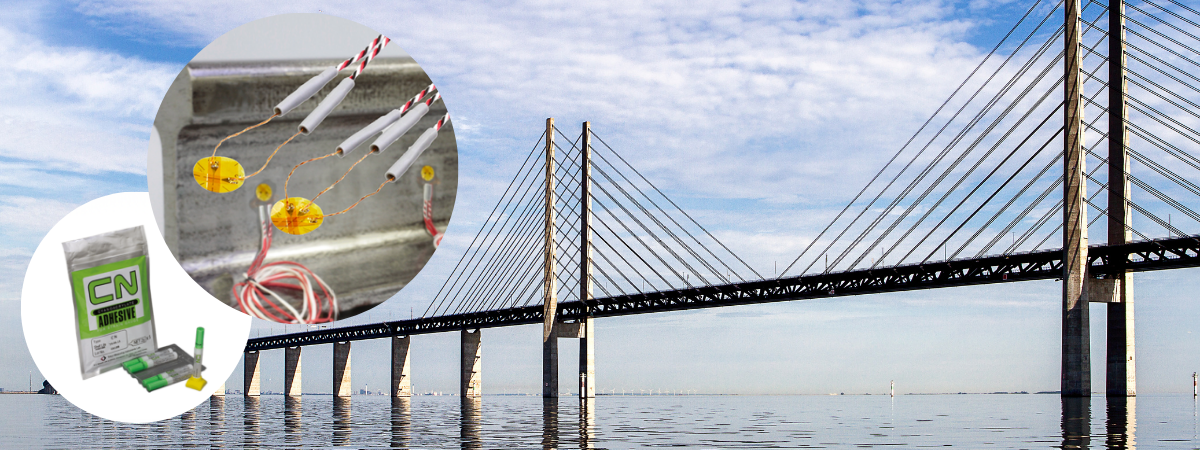
Bonding the strain gauge down correctly is, without a doubt, one of the most important factors when using strain gauges. Therefore, ensuring that you choose the correct adhesive and protective coating is essential. Take into account your strain gauge type, your test specimen material, the test temperature range and any other environmental considerations. We have created a helpful guide to make this process quicker. Please contact us if you require any assistance, and we will be happy to help.
In general, most strain gauges are installed on the surface of the test specimen using adhesive. As a result, measurement is possible as long as the specimen material is bondable with adhesive. This method can indeed be applied to various materials, including metal, concrete, wood, and composite materials. Moreover, after installation, it is crucial to apply coatings to protect the strain gauges and lead wires from various environmental conditions. Notably, the availability of this bonding type will depend on the operating temperature of the adhesive; notably, the maximum operating temperature is 300 degrees.
Here at Techni Measure, we offer a range of adhesive solutions for a wide variety of applications from our supplier, Tokyo Measuring Instruments (TML). Consequently, factors such as working conditions and the various requirements for bonding performance—particularly with regard to the operating temperature—are essential to consider.
There are Two Main Types of Curing Adhesive: Cold and Hot.
Cold-curing is usually the first choice as it’s ideal for quick installations thanks to its rapid bonding at room temperature. They’re ideal for experimental and field testing, including large structural monitoring, on-site stress analysis and prototype testing.
The hot-curing adhesives are only effective if you have suitable strain gauges that are suitable for heat curing. This enables reliable measurement for long periods and at high temperatures up to 200°C. Common uses of hot-curing include transducer manufacturing, structural fatigue testing and harsh, high-elongation environments.
Adhesives Available
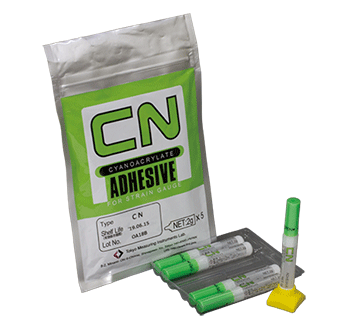
CN Adhesives (General purpose)
Single-component adhesive for strain gauges. The time required to bond the gauge is extremely short, and handling is very easy. The thin bonding layer allows adhesion to plastic objects as well as metal. Curing time under normal conditions is 20~60 seconds.
Operating Temperature: -196~+120°C
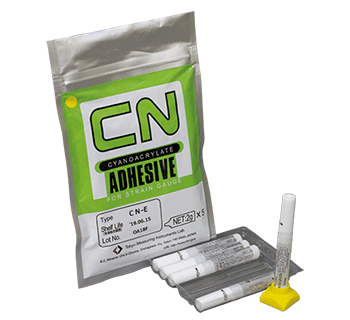
CN-E Adhesives (Concrete, Mortar)
Single-component adhesive featuring high viscosity for bonding strain gauges to porous materials such as concrete and mortar. Curing time under normal conditions is 40~120 seconds.
Operating Temperature: -30~+120°C
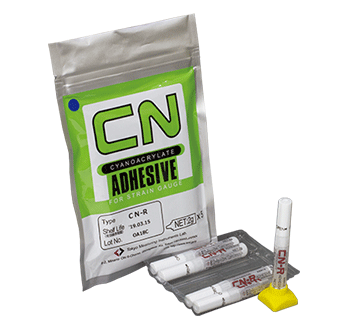
CN-R Adhesives (Fast hardened type for cold district)
Single-component cement for accelerating cures in lower ambient temperatures or lower relative humidity. Curing time under normal conditions is 10~30 seconds.
Operating Temperature: -30~+120°C
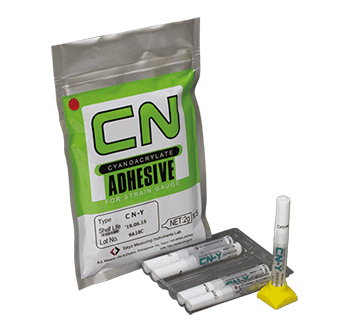
CN-Y adhesives (Post-yield)
Single-component adhesive designed exclusively for use on post-yield strain gauge. Offers minimum degradation in bonding performance (peel strength) due to ageing. Suitable when a large strain measurement is made after a few days or more of bonding the strain gauge. Curing time under normal conditions is 60~120 seconds.
Operating Temperature: -30~+80°C

P-2 adhesives (General purpose)
Two-component room-temperature-curing polyester adhesive for bonding PF, P and F series strain gauges. Use the mixed adhesive within 5~15 minutes. Curing time 2-3 hours.
Operating Temperature: -30~+180°C
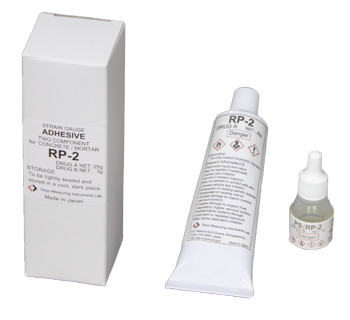
RP-2 adhesives (Concrete, Mortar)
Two-component room-temperature-curing polyester adhesive for bonding PF and P series strain gauges. Use the mixed adhesive within 10~20 minutes. Curing time 2-3- hours.
Operating Temperature: -30~+180°C

PS adhesives (Concrete, Mortar, Wood)
Two-component room-temperature-curing polyester adhesive. Used as a surface precoating agent for bonding P and PF series gauges to concrete and also as an adhesive for WFLM series gauges. The special filler exhibits alkali resistance and effectively shuts off moisture and gas from inside of the concrete. Its high viscosity enables use on vertical walls or ceilings. Curing time 2-3 hours.
Operating Temperature: -30~+100°C
NP-50B adhesives (High temperature)
Two-component room-temperature-curing polyester adhesive for bonding QF, ZF and BF series strain gauges. Use the mixed adhesive within 5~20 minutes. Curing time 16 hours.
Operating Temperature: -30~+300°C

C-1 adhesives (Long-term measurement, Transducer-specific)
Single-component heat-curing-type adhesive. For use on strain gauges that are suited to heat curing. Enables reliable measurement for long periods and in high temperatures up to 200°C.
Pre-curing at 130°C for 1 hour with pressure. Post-curing at 200°C for 1 hour without pressure.
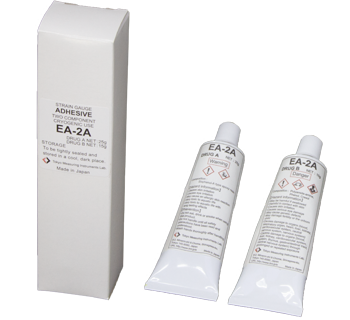
EA-2A adhesives (Cryogenic temperature)
Two-component room-temperature-curing epoxy adhesive for bonding CF series strain gauges for use in temperatures from cryogenic ( – 269 ℃) up to 50 ℃.
Pressure at 50~300kPa. Room temperature 1 day, or at 50°C 2 hrs.
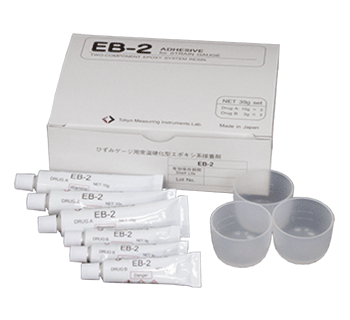
EB-2 adhesives (Long-term measurement)
Two-component room-temperature-curing epoxy adhesive for bonding strain gauges for use in temperatures from -60°C to +150°C. Enables stable measurement for a long period of time.
Room temperature 1 day
Pressure 50~200kPa.
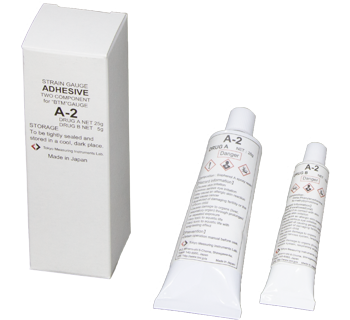
A-2 adhesives (Bolt embedding)
Two-component heat-curing epoxy adhesive for bonding BTM strain gauges. Keep at room temperature for 12 hours, then cure at 140°C in furnace for 3 hours.
Room temperature 12 hrs and 140°C 3 hrs.
We stock all of our adhesives in the UK for fast delivery. Many of these can be purchased directly from our online store for fast and easy payment and shipping. Checkout our online store to find out more regarding each individual adhesive. If you require any assistance with choosing your adhesive for your application, do not hesitate to contact us today. We are here to help.
