
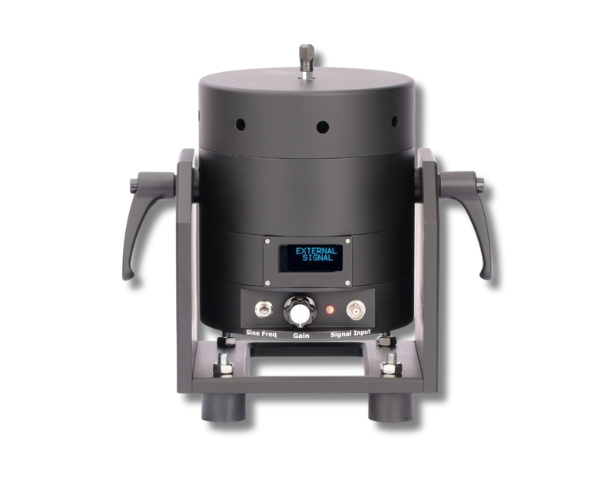
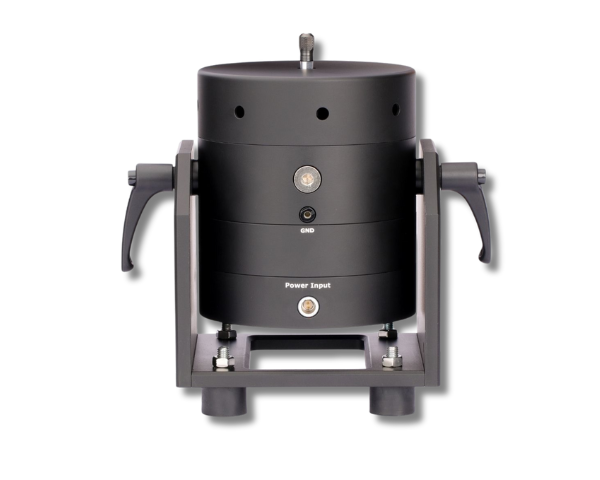
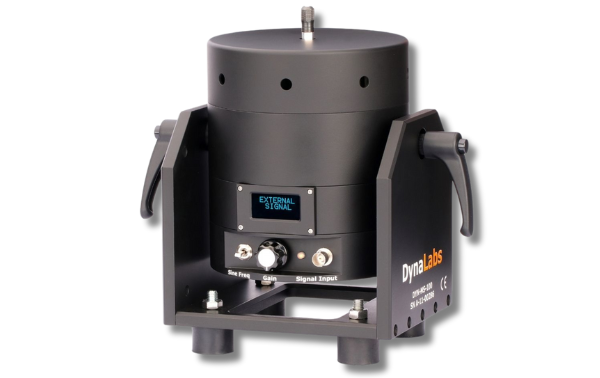
Modal Shakers
Modal shakers are used to study the vibration behaviour of structures. No specimen is mounted to these shakers; the shaker is attached to the structure via a stringer. Dynalabs modal shakers are lightweight and powerful, modal shakers capable of up to 12,000 Hz and force levels up to 440N with a maximum stroke of 25mm.
What are Modal Shakers?
Modal shakers are specialised electrodynamic devices used in structural dynamics testing to excite structures (like aircraft, automotive and machinery components) to determine their natural frequencies, damping, and mode shapes.
What are Modal Shakers?
Modal shakers are specialised electrodynamic devices used in structural dynamics testing to excite structures (like aircraft, automotive and machinery components) to determine their natural frequencies, damping, and mode shapes.
Applications:
• Component, machinery, vehicle testing
• Modal analysis of structures
• Aerospace testing
• Automotive testing
• Research and development
Advantages:
• The modal stinger can be easily adjusted by the through-hole armature
• Lightweight, durable, portable and easy to use
• Adjustable trunnion base provides high flexibility
• Up to 25mm stroke and broad frequency range
Applications:
• Components, Machinery, Vehicles testing
• Modal analysis of structures
• Aircraft and constructions
• Aerospace testing
• Automotive testing
• Research and development
Advantages:
• The modal stinger can be easily adjusted by the hole in the armature
• Lightweight, durable, portable and easy to use
• Adjustable trunnion base provides high flexibility
• Up to 25mm stroke and broad frequency range
How to select a Modal Shaker?

Dynalabs modal shakers cover a wide range of structures for dynamic characterisation. The output force of the modal shaker can reach up to 440N, and an excitation frequency of 12,000 Hz can be achieved. The following chart summarises the application ranges of the modal shakers. The size and weight of the structure are the main factors in selecting the appropriate shaker. However, for localised testing, small shakers such as the MS-20 can be used in any structure.
| Parameters | MS-20 | MS-100 | MS-250 | MS-440 |
|---|---|---|---|---|
| Output force (sinus) | 20N | 100N | 250N | 440N |
| Output Force (Shock) (4ms) | 35N | 117N | 350N | 590N |
| Frequency range | 0-12 kHz | 0-7.5 kHz | 0-5 kHz | 0-5 kHz |
| Displacement (Peak to peak) | 5 mm | 5 mm | 20 mm | 20 mm |
| Suspension type | Spring | Carbon Fibre | Carbon Fibre | Carbon Fibre |
| Max acceleration | 40 g | 60 g | 100 g | 100 g |
| Total mass | 4.1 kg | 7.3 kg | 11.5 kg | 11.8 kg |
| Max velocity | 1 m/s | 1 m/s | 1.6 m/s | 1.6 m/s |
| Cooling system | Natural Convection (For continuous operation at 20N forced cooling is suggested) | Natural Convection (For continuous operation at 100N forced cooling is suggested) | Forced convection | Forced convection |
| Operating range | 5-35°C | 5-35°C | 5-35°C | 5-35°C |
| Maximum Input Current | 4A (RMS) | 6A (RMS) | 10A (RMS) | 10A (RMS) |
| Amplifier | Internal | Internal | External (SA-400 / SA-500) | External (SA-400 / SA-500) |
| External signal voltage level | 1 VAC (peak) | 1 VAC (peak) | 10 VAC (peak) | 10 VAC (peak) |
| Power supply voltage | 19V DC | 24V DC | ||
| Power supply current | 4.74 A | 5A | ||
| Blower | X | X | DYN-BLW-511 | DYN-BLW-511 |
An amplifier is an essential component when using a vibration shaker, serving to amplify the input signal, control the excitation frequency, and manage the amplitude of vibrations.
For Dynalabs shakers, the 20N and 100N models are uniquely integrated with their amplifiers, which feature an LED screen for real-time frequency monitoring, streamlining the testing process and enhancing user convenience. For PM-10, inertial shakers, and other 250N and 440N shakers, the vibration system includes an external amplifier. So, all Dynalabs shaker systems are equipped with an amplifier to accommodate various testing requirements.
Dynalabs manufactures small electrodynamic shakers. Modal shakers are available in four sizes: 20N, 100N, 250N, and 440N. Permanent magnet shakers come in five sizes ranging from 10N to 440N. Meanwhile, inertial shakers have four sizes: 5N, 10N, 20N, and 40N, with sinus output force.
A vibration shaker is a mechanical testing device used to replicate and simulate different types of vibrations, mechanical stresses, and dynamic movements that components, products, or structures may encounter under real-world circumstances. The system usually consists of a mechanical device that can produce regulated motion, which allows it to subject objects to controlled vibration, including sinusoidal, random and shock vibration. Vibration shakers are widely used in industries such as aerospace, automotive and electronics to evaluate the reliability, durability and performance of products. They play a significant role in identifying design flaws and weaknesses, ensuring product quality and preventing costly failures.
Vibration testing is essential to assess how products and components respond to dynamic forces and vibrations in real-world conditions. It helps identify natural frequencies, which are inherent to structures and components and can lead to resonance-induced failures if not properly addressed. Modal testing and analysis, a part of vibration testing, provide insights into the mode shapes or vibrational patterns of objects, helping optimise designs for enhanced performance, safety, and reliability. In sum, vibration testing, with its focus on natural frequencies and mode shapes, is a critical quality control and safety assurance tool across various industries.
A Modal Vibration Shaker, also known as a Modal Shaker, is a specialised type of vibration testing system designed for performing modal analysis on structures and components. Modal analysis is a technique used to study an object’s natural frequencies, mode shapes, and damping characteristics. Modal shakers are equipped with the capability to excite the structure or component under test at specific frequencies and record its responses, allowing engineers and researchers to determine its dynamic behaviour. Modal shakers are attached to the structure with a stinger, and the force is transferred from the shaker to the structure via this stinger.
A Permanent Magnet vibration shaker is a type of vibration testing system that uses permanent magnets to generate controlled vibrations. These shakers are designed to subject products, components, or structures to various types of vibrations, including sinusoidal, random, or shock vibrations. These tests can be conducted with the specimen attached directly to the shaker armature. The use of permanent magnets as the driving force distinguishes them from other types of vibration shakers, which may use electromagnets or other mechanisms. Permanent magnet vibration shakers are known for their durability, efficiency, and precision in simulating real-world vibration conditions for testing and analysis purposes in industries such as aerospace, automotive, and electronics.
An Inertial Vibration Shaker is a testing device used for examining the vibrational behaviour of structures, similar to modal shakers. However, the key distinction lies in their connection styles. Inertial shakers vibrate their own bodies, making them directly fixed to the structure under test, simplifying the testing process compared to modal shakers. They are particularly suitable for use with larger structures and offer ease of use. These shakers can be utilised for modal testing, depending on the desired excitation frequencies and levels.
