
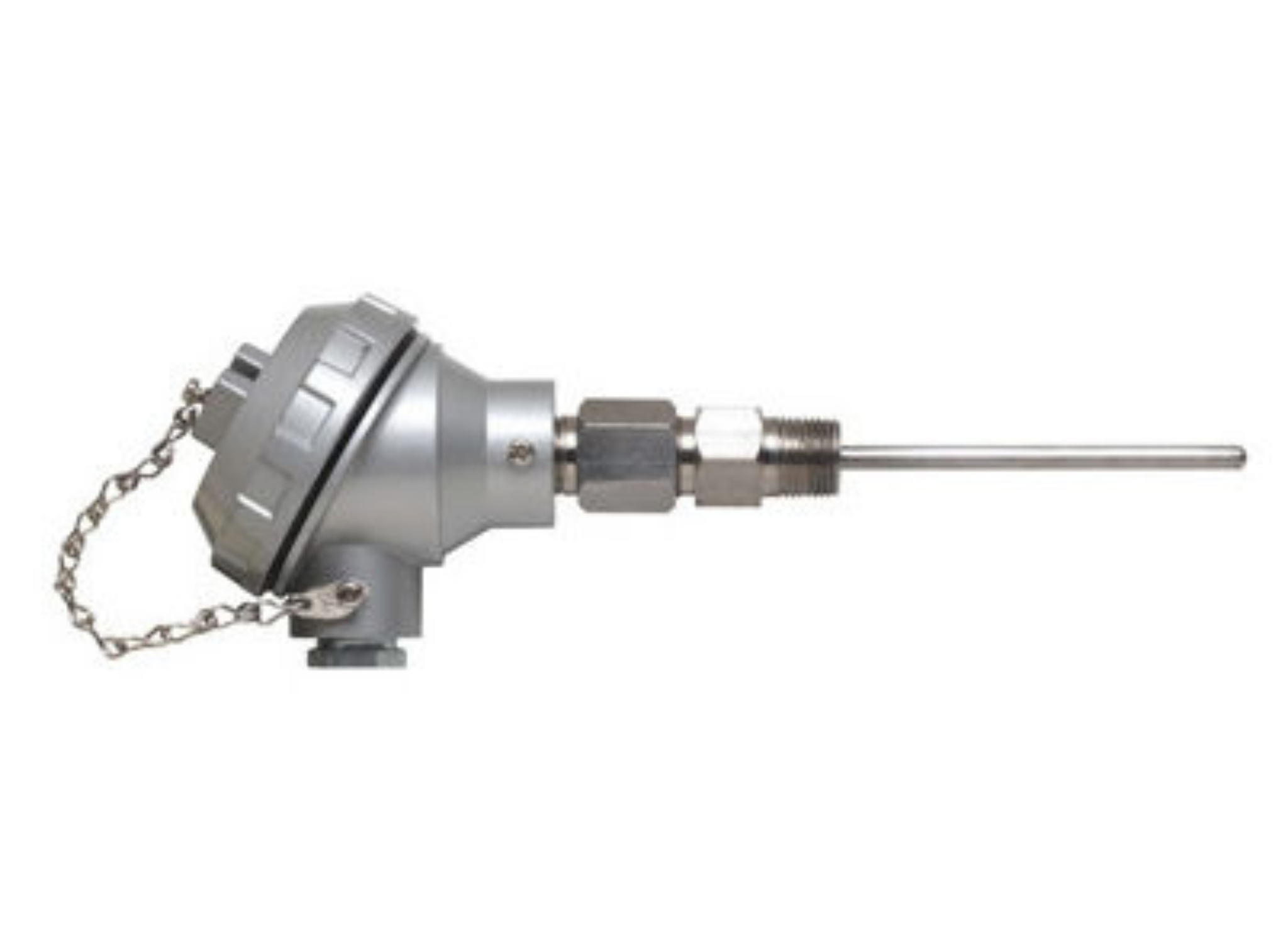
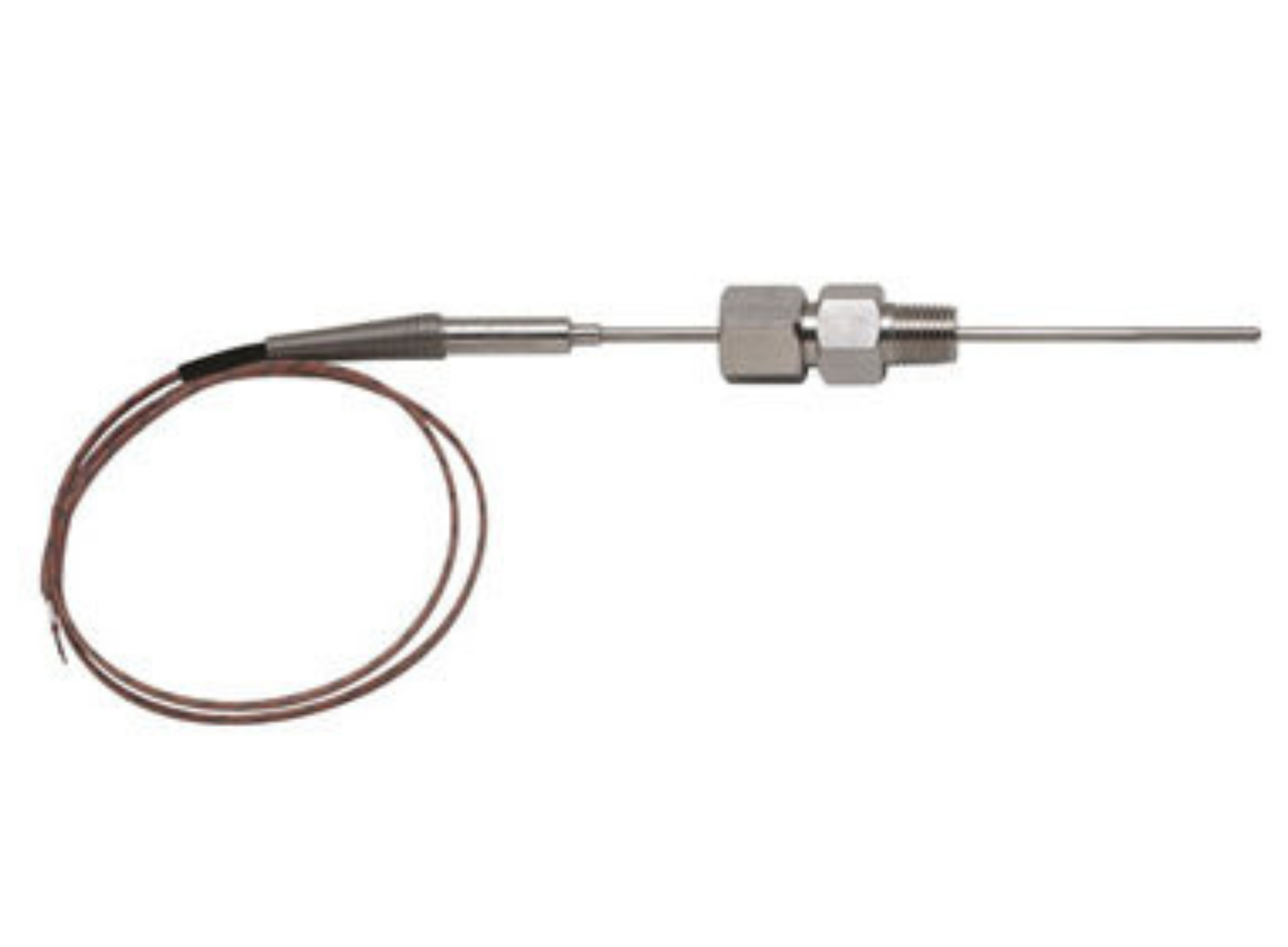
Thermocouple operation is based on the fact that when wires of two different materials are joined together at one end and placed in a temperature gradient, a thermoelectric voltage is observed. Various materials are used to obtain the best output for any given temperature range, and these are described by the ISA letters T, J, E, K, etc. Various sensor elements, sheath materials, probe constructions and mounting styles are available.
| SERIES | DESCRIPTION | RANGE F.S. | REMARKS |
|---|---|---|---|
| J Type | Iron vs Copper Nickel (Constantan) | 0° C to +760° C | For use in reducing atmospheres. Iron may oxidise if unprotected in oxidising atmospheres. Limited use possible in oxidising atmospheres at high temperatures; not recommended at low temperatures. |
| K Type | Nickel-Chromium vs Nickel-Aluminium | -200° C to +1260° C | For use in oxidising atmospheres. Not recommended for reducing atmospheres. |
| E Type | Nickel-Chromium vs Copper-Nickel | -200° C to +870° C | Good for use in oxidising atmospheres. The highest EMF output of the common thermocouples. |
| T Type | Copper vs Copper-Nickel (Constantan) | -200° C to +370° C | For use in oxidising, reducing and inert atmospheres. Capable of cryogenic temperature service. Good where moisture is present. |
| N Type | Nickel-Chromium-Silicon vs Nickel-Silicon-Magnesium | 0° C to +1260° C | Less affected by the order/disorder transformation that causes calibration shifts in Type K. For use in oxidising atmospheres. |
| S/R Type | Platinum-Rhodium vs Platinum | 0° C to +1480° C | For use in oxidising atmospheres. Alumina protection tubes are recommended to resist contamination at elevated temperatures. |
| B Type | Platinum-30% Rhodium vs Platinum-6% Rhodium | +870° C to +1700° C | For use in oxidising, inert, or vacuum atmospheres. Alumina protection tubes are recommended to resist contamination at elevated temperatures. |
| C Type | Tungsten-5% Rhenium vs Tugsten-26% Rhenium | 0° C to +2315° C | For use in hydrogen, inert or vacuum atmospheres. |
When selecting a thermocouple assembly from Conax Technologies, there are several important choices to consider. First, you need to determine the type of thermocouple required, as this will depend on the temperature range of interest.
Next, you’ll need to select the sheath material and specify the size, including both the diameter and length. Additionally, let us know whether you require a grounded or ungrounded tip, and if you need a reduced tip or bare wires for quicker readings.
Termination styles can vary widely, ranging from simple wire connections to cable assemblies, as well as fitted terminal head boxes with or without electronic modules. You might also want to consider mounting options, such as using a pressure sealing gland, which Conax Technologies can provide.
Given the numerous variations available, we’re here to assist you in finding the best solution for your needs. Please don’t hesitate to reach out for help!
Comparison of Sensor Types
ADVANTAGES
THERMOCOUPLE
- Self-powered
- Simple, rugged
- Inexpensive
- Wide variety
- Wide temperature range
RTD
- Most stable
- Most accurate
- Better linearity
DISADVANTAGES
- Some non-linearity
- Reference junction required
- Least stable
- Least sensitive
- Expensive
- Current source required
- Self-heating
