
How to Protect Your Strain Gauges from Environmental Factors
Strain gauges are an extremely useful measuring tool for strain and stress measurement, but they’re also sensitive instruments. Protecting strain gauges from environmental factors is essential for ensuring accurate long-term measurements. A bare strain gauge is highly sensitive to its surroundings, making protective coatings crucial for several reasons:
1. Moisture and Humidity Protection: Coatings prevent water absorption, which can lead to corrosion and inaccurate readings.
2. Mechanical Protection: They shield the gauge from physical damage and debris.
3. Chemical Resistance: Coatings protect the gauge from harsh environments, including oils, gases, and salt air.
4. Enhanced Stability: They ensure long-term, accurate measurements, especially in field applications.
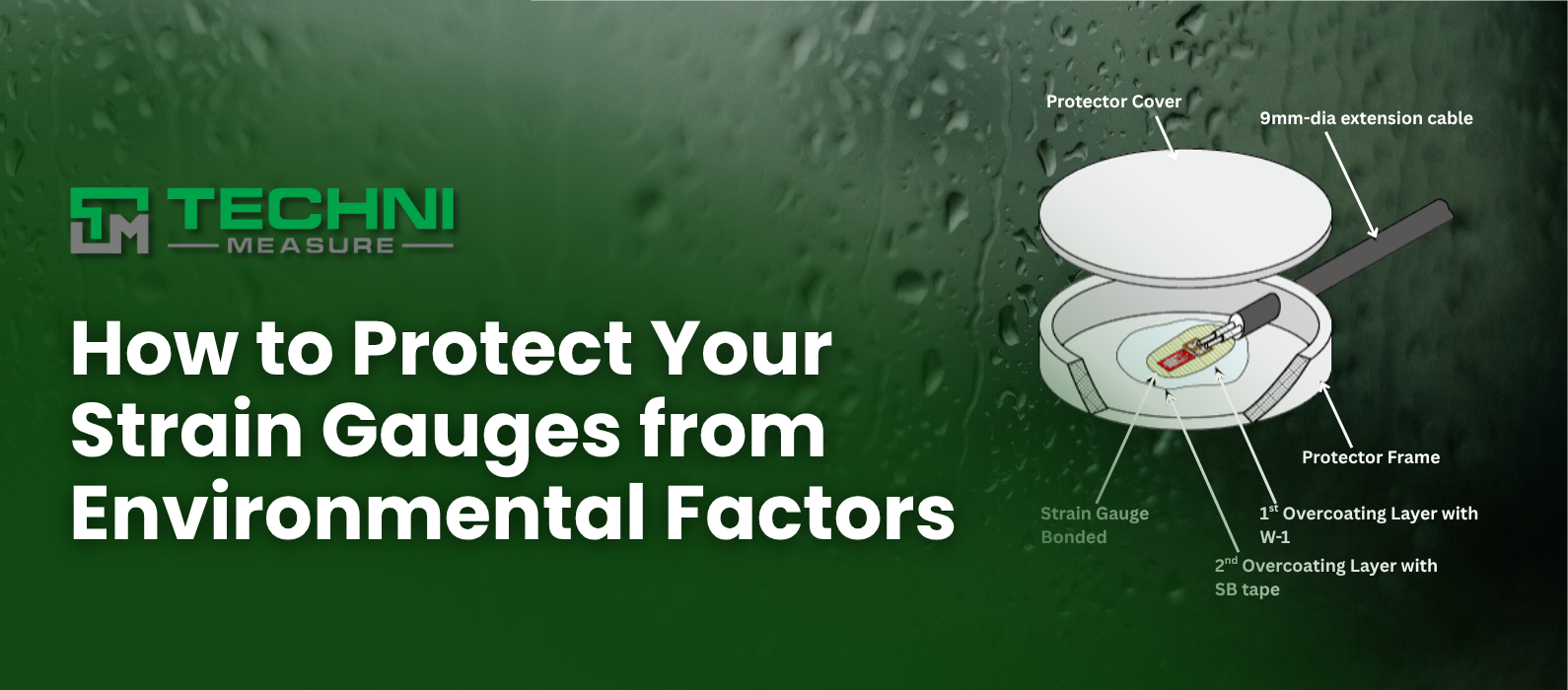
There are various methods to protect your strain gauges, including coatings, waterproof tape, and general-purpose microcrystalline wax. Strain gauge coatings are protective materials applied over a strain gauge once it has been bonded to a test surface. These coatings play a crucial role in preventing moisture absorption, electrical leakage, and mechanical damage to the sensor. Waterproof tapes and general-purpose microcrystalline wax serve similar purposes, providing protective and moisture-proof solutions.
All of these are available on our online store for quick delivery: https://store.technimeasure.co.uk/product-category/strain/accessories/adhesives-coatings/-
Here is a list of the available protective coating materials:
| Type | Type of Coating Materials | Operating Temperature | Curing Conditions | Materials |
|---|---|---|---|---|
| W-1 | Hotmelt | 0 to +50℃ | Hot melting at +100 to 120℃, hardening at room temperature | Microcrystalline wax solid |
| N-1 | Rubber-type solvent | -30 to+80℃ | Air-drying, a half day at room temperature | Special rubber based solvent thinned |
| K-1 | Rubber-type solvent | -269 to +60℃ | Air-drying, a half day at room temperature | Special rubber-based solvent thinned |
| UE-1 | Rubber-type solvent | -40 to +150℃ | Air-drying, a half day at room temperature | Special rubber-based solvent thinned |
| SB tape | Rubber-type pressure-sensitive | -30 to +80℃ | Pressure sensitive | Butyl rubber |
| VM tape | Rubber type pressure sensitive | -20 to +80℃ | Pressure sensitive | Butyl rubber |
Here are some key environmental factors that can impact strain gauge accuracy and lifespan:
- Temperature and Thermal Cycling
Apparent Strain: Changes in ambient temperature can alter the electrical resistance of the grid material and cause differential thermal expansion between the gauge, adhesive and test structure, which the sensor misinterprets as mechanical load.
Thermal Drift: Rapid temperature swings or extreme heat weaken solder joints and degrade adhesive, causing long-term signal drift and hysteresis.
2. Humidity and Moisture
Water Ingress: Moisture can seep into the backing or adhesive layer, lowering insulation resistance and causing corrosion.
Bond Failure: Fluid penetration breaks down the bond between the sensor and the substrate, leading to severe signal instability and false readings.
3. Vibration and Mechanical Shock:
Fatigue: Continuous heavy vibration accelerates mechanical wear on lead wires and solder joints.
Wire Breaks: Severe cyclical shock can fracture delicate internal grid connections or compromise the structural integrity of the adhesive layer.
4. Electromagnetic Interface (EMI)
Electrical Noise: Nearby high-voltage equipment, motors, or radio frequencies induce unwanted electrical currents and hum into the unshielded lead wires.
Signal Distortion: Poor grounding exacerbates noise, masking the very small resistance changes intrinsic to strain measurements.
5. Chemical Exposure and Corrosion
Aggressive Media: Direct contact with oils, solvents, salt spray, or industrial chemicals corrodes the metallic foil grid and degrades protective polymer coatings.
Adhesion Loss: Chemical attacks dissolve bonding agents over time, resulting in complete sensor detachment.
