
What is Vibration and How to Test It?
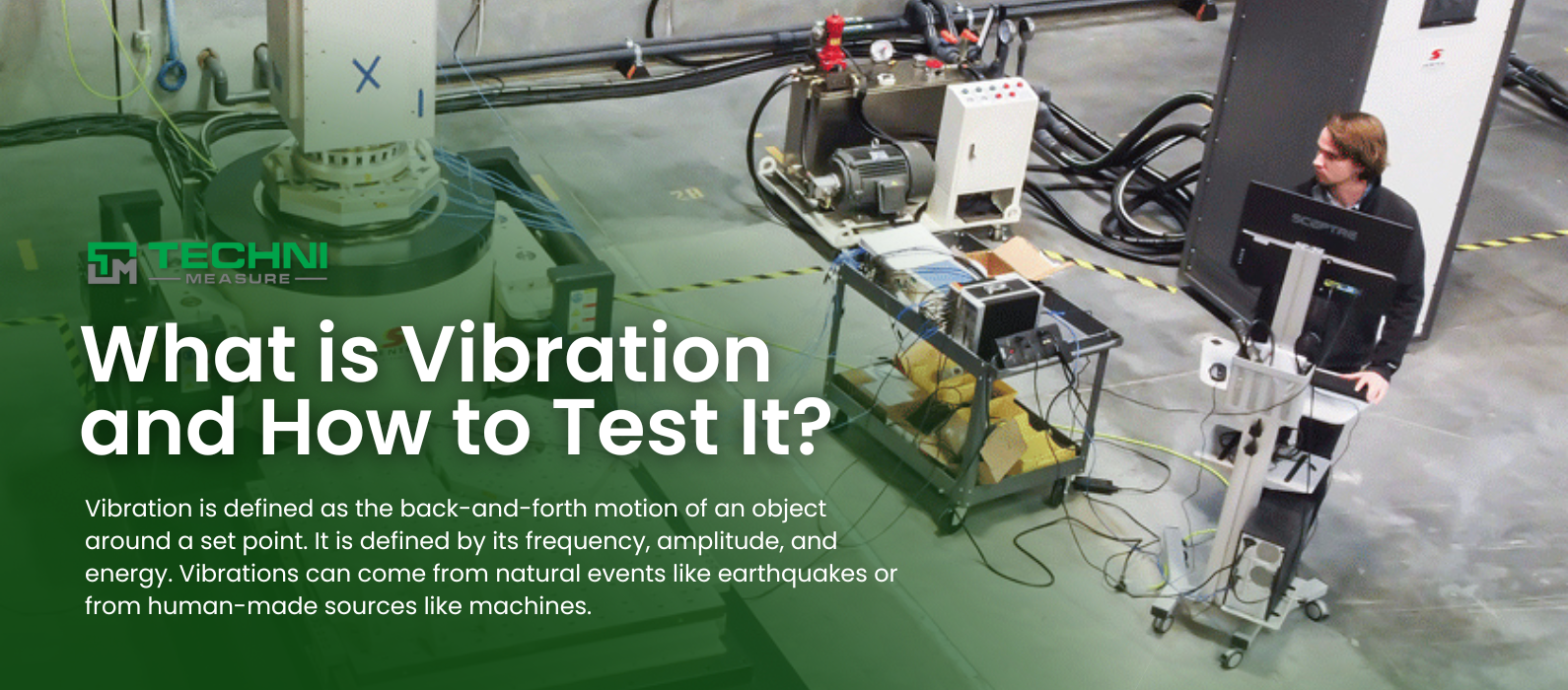
Vibration is defined as the back-and-forth motion of an object around a set point. This motion is characterised by a to-and-from movement that occurs at consistent intervals, defined by particular parameters such as frequency, amplitude, and energy. Vibrations can arise from natural occurrences, such as earthquakes, or from human-made sources, like machinery.
Basics of Vibration Testing & Analysis
Structural vibration testing and analysis play a crucial role in various industries, such as aerospace, manufacturing, defence, and more. The primary application focuses on identifying and mitigating unwanted vibrations to enhance product quality.
Unwanted vibrations can cause wear and tear or decrease how well a structure performs. That’s why it’s crucial to find ways to lessen their impact.
But sometimes, vibrations are unavoidable or even helpful. In those cases, we focus on understanding how they affect the structure, managing or adjusting the vibrations, or isolating them to keep the structure safe and sound.
Vibrations can be classified into various categories based on their source, behaviour, and direction. Some examples include:
– Free Vibration
– Random Vibration
– Forced Vibration
– Shock Vibration
– Sine Vibration
Each type of vibration has unique characteristics, causes, and implications. By studying these different categories, engineers can effectively predict, analyse, and address vibration-related challenges.
Types of Vibrations
Free Vibration
Free vibration refers to a type of vibration in which a system, once set into motion, vibrates at its natural frequency without any external influence.
An example of this is when a bridge vibrates after a vehicle has passed over it. Vibration testing is conducted for structural health monitoring (SHM) to assess the bridge’s dynamic characteristics, such as its natural frequency and damping ratios. These properties can provide valuable information about the bridge’s structural integrity and help detect potential damage.
As a vehicle travels across the bridge, its mass and suspension dynamics excite the bridge structure, causing it to vibrate. After the vehicle leaves the span, the bridge experiences a brief period of free vibration, responding naturally to the initial excitation based on its inherent natural frequencies. The recorded vibrations are analysed, and the natural frequencies are compared to baseline data from the undamaged state of the bridge. A significant change in the bridge’s natural frequency or mode shape can indicate a change in stiffness or the presence of damage, such as cracking or erosion.
Understanding free vibration is crucial for architects and civil engineers, as buildings and bridges are designed with natural frequencies that differ significantly from the frequencies of potential external vibratory loads, such as wind, traffic, or seismic activity. This design consideration helps to minimise resonance, a phenomenon that can lead to excessive vibrations.
Random Vibration
Random vibration is an unpredictable, non-repeating mechanical motion with energy across many frequencies and no repeating pattern.
Railway tracks are a real-world example of random vibration because the forces generated at the wheel-rail interface are inherently unpredictable and variable, primarily due to unavoidable imperfections in the track and wheels.
These irregularities mean the resulting vibrations do not follow a simple, predictable pattern (like a perfect sine wave), but rather a complex, non-stationary process that must be modelled statistically.
The primary source of random vibration stems from the dynamic interaction between a train’s wheels and the track surface:
- Track Irregularities
No track is perfectly smooth. Variations in the track include rail roughness, rail joints and overall unevenness. - Wheel Imperfections
Train wheels are not perfectly round and can develop flat spots or wear over time, differing among wheels in a train. - Variable Conditions
Factors like train speed, type and weight of the train, and environmental conditions create variability in the forces generated.
Forced Vibration
Forced vibration refers to a type of vibration that occurs when an object vibrates at the frequency of an external force, rather than its own natural frequency. This method enables the analysis of the system’s dynamic response, helps identify its natural frequencies, and ensures that it can endure the vibrations experienced during real-world operations.
An Example of Forced Vibration
Consider a car’s suspension system navigating a bumpy road. In forced vibration testing, an external, time-dependent force or motion is continuously applied to the system. Here, the system consists of the car’s suspension and body, while the external force comes from the uneven road surface—bumps and potholes—which imparts a consistent input into the wheels and suspension.
The suspension system (including springs and shock absorbers) is specially designed to manage and dampen these forced vibrations. It converts the kinetic energy generated by the bumps into heat, ensuring a smooth and safe ride.
Shock Vibration
Shock testing simulates sudden energy transfers to determine whether products can withstand drops, impacts, explosions, or rough handling.
This includes tests such as drop shock, pyroshock, thermal shock, and classical pulses generated on drop towers or shakers to replicate real-world events like potholes or vehicle crashes. The goal is to ensure that electronics, automotive parts, and packaged goods can endure harsh conditions.
For instance, rocket engines and landing gear systems undergo rigorous shock tests to verify their durability against sudden jolts and long-term operational stresses.
These tests are crucial for preventing failures that could lead to serious malfunctions or catastrophic outcomes, ultimately ensuring the safety and reliability of aerospace vehicles.
Sine Testing
Sine Vibration Testing is a basic vibration method where a device is subjected to a single-frequency sinusoidal (sine wave) tone at a specific amplitude for a set duration.
The focus of sine vibration testing is to evaluate how an object performs under constant vibration in the safe environment of a testing laboratory. A sine vibration exposes the object or structure to a sine wave at a defined amplitude and frequency.
During a sine vibration test, a device under test (DUT) is subjected to a single-frequency sine wave at a specified amplitude for a set duration. There are various methods to conduct a sine test. For instance, an engineer may perform a sine sweep to expose the DUT to a single sine tone while varying the frequency across a defined range.
Key Purposes:
- Identifying Resonances: This test helps identify frequencies at which the product vibrates most, which aids in preventing structural fatigue.
- Design Validation: The test qualifies product designs for specific environments, such as the low-frequency launch conditions experienced by spacecraft.
- Durability Testing: It serves as an endurance test, sometimes referred to as bounce or repetitive shock testing, to determine if a product can withstand repeated stress.
Why Choose a Sine Test?
- Simplicity: A sine test is considered one of the simplest and most reliable vibration tests available.
- Visual Clarity and Accuracy: Because the sine vibration test operates through a user-defined profile at a single frequency at any given time, it achieves a higher signal-to-noise ratio and produces a clear response.
- Focused Approach: A sine vibration dwell is an effective method for testing the endurance and durability of a structure at its natural resonance frequencies.
How to Test Vibration?
There are numerous methods available for conducting a vibration test. We are pleased to provide a comprehensive solution for your vibration testing needs.
Our extensive product lineup includes offerings from various suppliers, such as Sentek Dynamics shakers, Dynalabs shakers, Crystal Instruments vibration test controllers, and modal analysis hammers and accelerometers from Dytran by HBK.
 D5 Creation